Who's Who in Legendre Conjecture Research
A directory of researchers working on Legendre's conjecture
Legendre's conjecture, raised by Adrien-Marie Legendre in the early nineteenth century, asks whether a prime always exists between n2 and (n+1)2 for every positive integer n. It is one of the four prime problems Edmund Landau called unattackable in 1912. The conjecture remains open.
This site is a reference directory of the researchers most active on Legendre's conjecture and the broader program of distributing primes in short intervals (small prime gaps and sieve methods). It catalogs the Top 100, ranked from arXiv preprint output, OpenAlex citation data, and zbMATH classifications, with their institutions, and offers a curated reading list.
Where to start
- Home: This page.
- The Top 100: the canonical ranked list, sortable and filterable in your browser.
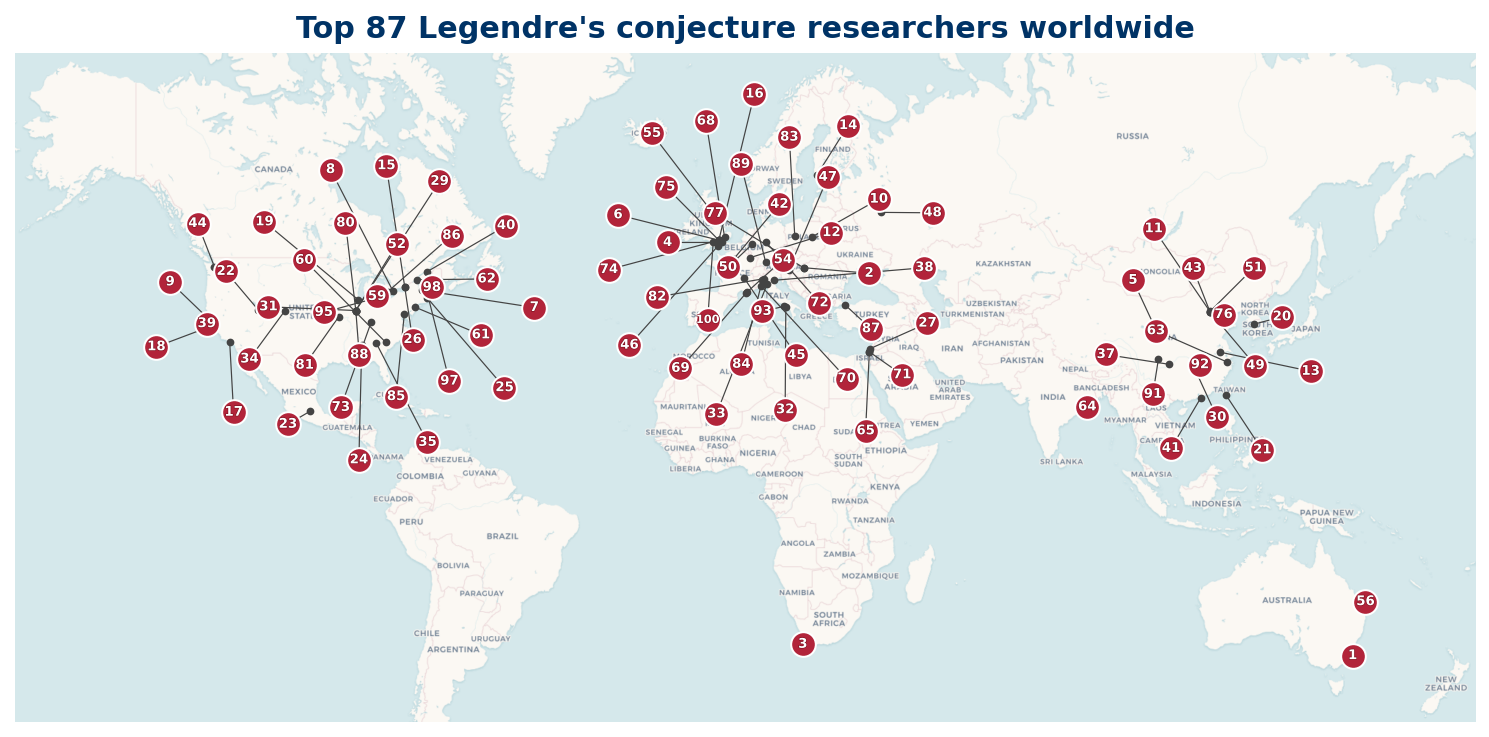
- Locations: where the Top 100 are based, shown by world region with maps.
- Institutions: the institutions ranked three ways: where the Top 100 work today, where they earned their PhDs, and a canonical blend of the two.
- In Memoriam: researchers in this directory who are no longer with us.
- Genealogy: close relations of the Top 100 through advisor-student lineage in the Mathematics Genealogy Project.
- Six Degrees: the coauthorship graph among the Top 100: who has written papers with whom, and how few steps separate any two of them.
- Reading List: the recent topical papers ranked by the prominence of their authors in this directory, plus the most-cited papers of all time.
- Overlap: the researchers who also appear across the related conjecture sites.
- About: what this site is, who built it, and where to find the methodology, the open dataset, and how to request a correction.